
MEMO-6 March 2026
The Other Side of the Diagnosis

We just spent three months studying how India diagnoses disease. Now we’re exploring how India treats it.
The good news: there’s a lot of room. The better news: someone has to build it.
Our latest report- IVD’s Inflection Point– started with a simple provocation: India isn’t short on diagnostic tests. It’s short on diagnostic value. The real opportunity isn’t cheaper tests, it’s “more biology per rupee”- earlier signals, richer clinical insight, decisions that actually change outcomes. Our favourite insight from the report was:
Rs 2 lakh per patient per year for Dialysis
Rs. 400 per patient for early detection
But the technology itself is anything but modest. A new generation of diagnostics is reshaping what’s even possible. Point-of-care chip systems that compress an entire laboratory onto a device small enough to sit at a clinic in rural Maharashtra. Multi-omics platforms that don’t just answer “positive or negative” but characterise disease risk, progression, and response with a precision that would have seemed excessive five years ago.
AI-augmented tools that extend specialist expertise into settings that have never had a specialist.
Three distinct categories, each attacking a different constraint- infrastructure, signal depth, workforce- all converging on the same idea: more biology per rupee.
What struck us most wasn’t the ambition. It was seeing it already happening. The founders we spoke to- building credible, scalable hardware IVD platforms, already with connectivity and AIMl algorithms in mind. They are developing AI-enabled multi-molecule biopsy tests for reliable point of care oncology screening. This is not building for India’s needs alone. They are building world-class products. With the right funding, the right ecosystem support, and the right regulatory runway, these companies have a genuine shot at reshaping how diagnostics work- not just here, but globally.
India, it turns out, is not just a large market. It is a forcing function for innovation. Building for a population this large, this diverse, this cost-sensitive, and this underserved produces solutions that are inherently more robust, more scalable, and more transferable than anything designed in a well-resourced system with nowhere to push back.
Build in India, for the world. That’s where this is going. Innovate in India and this does not mean we only sell in India or develop in an Indian silo.
So we started thinking about the other end of the care continuum.
Because a diagnosis is only the beginning of a story. At some point, someone has to actually fix the problem. That’s where the hard-tech comes in- interventional, invasive, impactful. Deals with the hard (difficult, constrained) problems. Has hard solutions (tangible but often complex). Needs cold hard cash (lots of funding) along with people not afraid of the long hard road (grit and resilience). These are devices that go into the body to fix, supplement, replace and heal the body. Implants, catheters, surgical robotics. The category where engineering meets harsh biology and neither gets to compromise because of the stakes.
India has the clinicians. It has the engineers. It has patients– more of them, with more conditions, than almost anywhere else- who would benefit from both better diagnostics and better interventions. Interventions can demonstrate immediate impact and don’t require the “sell” of prevention. While prevention may be better than the cure, people still resonate with a literal pain point eliminated.
What it’s still assembling is the ecosystem that connects these pieces: the clinical networks, the precision manufacturing, the patient capital, the regulatory clarity and expertise. The only way to really lower our import dependencies is to intervene at the interventional level.
The IVD founders are already proving it can be done. The interventional space is asking the same question, one beat behind.
Which makes this, depending on how you look at it, either a very hard problem or a very interesting moment.
Grants Spotlight
MAHA MedTech Mission — Government of India
A landmark ₹750 crore, 5-year initiative by ANRF in collaboration with ICMR and the Gates Foundation, backing indigenous development of medical devices and IVDs — including robotics, minimally invasive technologies, implants, and AI/ML platforms. The first funding round has closed, but two more calls are expected over the mission’s lifetime. If you haven’t registered on the ANRF portal yet, now is the time to get familiar with the process.
Funding per project: ₹5 crore – ₹50 crore (milestone-linked, no equity sharing required) Watch: anrfonline.in
Indo-Swiss Joint Research Programme (ISJRP) 2026 — ICMR, DBT & SNSF
Open call for collaborative research projects between Indian and Swiss institutions under a One Health framework — human, animal, and environmental health intersections. Relevant for founders with academic or research institution partners looking to build international credibility and bilateral R&D relationships.
Funding: Up to ₹2.5 crore (Indian side) for up to 4 years
Application deadline: May 5, 2026
Apply via: snf.ch
About the newsletter
India’s market rewards those who can navigate, not just innovate. Regulations and red tape aren’t going away — but with the right guidance, they can become your competitive edge.
At Just Yukti, we help you move through India’s complexity with clarity, confidence, and a little strategic yukti.
Subscribe to explore how we turn India’s challenges into opportunities for growth.
MEMO-5 February 2026
The importance of a well-defined problem statement in healthtech

During the course of our work at Just Yukti, we meet all kinds of entrepreneurs. First-timers, serial entrepreneurs on their 5th startup and everyone in the middle. And we have realized one thing: Success often starts with a well-defined problem statement.
Many people think a problem statement is decorative – something to fill in slide 2 of the pitch deck to show investors that it is a billion dollar market and they need to give you money. But a well-defined statement is so much more than that.
Let us take a fictional startup RapiDx. They are developing IVDs for sepsis.
Their first version sounded familiar: “Sepsis affects 9 million people annually in India. To tackle this problem, we’ve built a high-sensitivity molecular test for early sepsis detection.” Technically correct. Seems to signal a large problem. But it is still very fuzzy and superficial – why is sensitivity important? Why is early detection important?
After spending time in ICUs, hospital labs, and antibiotic stewardship committees, the problem statement sharpened: “In hospitals, blood culture results take 48–72 hours leading to clinicians prescribing medication for sepsis without reliable pathogen data in the first critical 6 hours. This leads to antibiotic overuse, subsequent resistance and higher costs. We have developed a high-sensitivity molecular test that gives clinicians actionable pathogen ID within just 15 minutes”
See the difference?
That specificity is powerful. It signals subject-matter depth without trying too hard. It tells the listener that this is a team who feels the problem, who can communicate the pain to the customer. Investors don’t need to be intensivists to recognize that this team understands workflow timing, lab bottlenecks, and stewardship pressures..
It also forces multidisciplinary alignment. Engineers stop obsessing only over analytical sensitivity and start focusing on turnaround time and integration with lab workflows. Clinical advisors clarify where the test actually fits in decision-making. Commercial teams understand who feels the pain most – ICU heads, infection control committees, hospital administrators.
In regulated environments, this clarity matters even more. The problem statement helps define intended use early. Is RapidDx a rule-in diagnostic? An adjunct to blood culture? A triage tool to guide early antibiotic decisions? That distinction shapes the regulatory pathway, risk classification, and the clinical validation plan – right from the get-go.
It even sharpens clinical validation. Instead of hand-wavy claims about “better outcomes,” (or worse, measuring the wrong outcome entirely), RapidDx can measure what actually matters: time-to-targeted therapy, reduction in broad-spectrum antibiotic days, ICU length of stay.
Startups don’t need bigger visions. They need sharper questions. A strong problem statement is often the first real proof that a team understands the system it’s trying to change.
Union Budget 2026 – and what it means for medtech startups.
February means Union Budget time in India. And this year is a continuation of the theme of previous years, along with quiet additions: scale infrastructure, deepen reimbursement, localize manufacturing, and strengthen research. For health and medtech founders, this is a system-building budget.
Here’s our take on key highlights from the Budget
Health Spending Sustains Above ₹1.1 Lakh Crore
Public health allocation remains above ₹1 lakh crore, with continued capex under PM-ABHIM (₹64,000+ crore outlay). Critical care blocks, district labs, and surveillance systems continue expanding.Diagnostics, imaging, AI-triage, and hospital IT now plug into more predictable procurement cycles.
PM-JAY as a Demand Engine
With ~55 crore beneficiaries and annual claims exceeding ₹80,000 crore, Ayushman Bharat PM-JAY is now a reimbursement backbone. If your solution aligns with a package code, you’re tied to a government payment rail, not just hospital budgets.
Digital Health Is Infrastructure
With 50+ crore health accounts created under ABDM, interoperability is no longer optional. API-ready, ABDM-compliant solutions will move faster in both public and private ecosystems. Many state governments already mandate ABDM-compliance as a pre-requisite for tenders – it’s only a matter of time before the others catch up as well.
Manufacturing Momentum
The ₹3,400 crore PLI scheme and the National Medical Devices Policy 2023 aim to reduce 70–80% import dependence in high-end devices and IVDs. Domestic manufacturing economics are improving – especially for export-oriented startups.
Clinical Trials Expansion
This was the most interesting addition – a proposed network of 1,000+ accredited clinical trial sites strengthens India’s research backbone. For founders, this means faster validation, broader recruitment pools, and stronger global credibility for Indian data.
Capital & Tax Support
- ₹10,000 crore Fund of Funds (SIDBI)
- Expanded Credit Guarantee Scheme for Startups
- Section 80-IAC tax exemption continuity
- Angel tax relief for DPIIT-recognized startups
The Big Picture: As with previous years, the takeaway remains the same. Manufacture locally. Integrate digitally. Align with reimbursement. Generate clinical evidence. Healthcare founders who think in systems will be best positioned to scale.
Grants Spotlight
MIT Solve Future Health Challenge: Building Anticipatory Health Systems through Population Sensing
Global open innovation call (worldwide) to develop sensing-enabled technologies that help health systems predict and prevent disease, shifting from reactive to anticipatory care.
Application deadline: February 23 2026.
Prize: USD 200,000 grand prize + two USD 50,000 runner-up prizes (plus honourable mentions & visibility/mentorship).
https://solve.mit.edu/challenges/future-health-challenge
About the newsletter
India’s market rewards those who can navigate, not just innovate. Regulations and red tape aren’t going away — but with the right guidance, they can become your competitive edge.
At Just Yukti, we help you move through India’s complexity with clarity, confidence, and a little strategic yukti.
MEMO-4 January 2026
Big Numbers, Bigger Questions: Inside India’s Digital Health Push

India has done something pretty rare in digital health: it’s actually built the plumbing.
With the Ayushman Bharat Digital Mission (ABDM), the country has put in place digital health IDs, registries, consent frameworks, and interoperability standards at a scale most health systems only talk about. That part deserves real credit.
But once the infrastructure is live, the harder questions begin. Questions that we felt needed answers to STAT, so our healthcare system can leapfrog beyond challenges.
So we did a thing this past December.
We looked at the hard data, crunched the numbers and came out with our very first whitepaper. This report looks at ABDM at this exact moment – when the excitement of building is giving way to the realities of use. We asked a simple question: now that the system exists, what has actually changed at the grassroots level? And used three very different lenses to answer the question: a policy and comparative benchmarking lens, an economic lens and a sentiment lens.
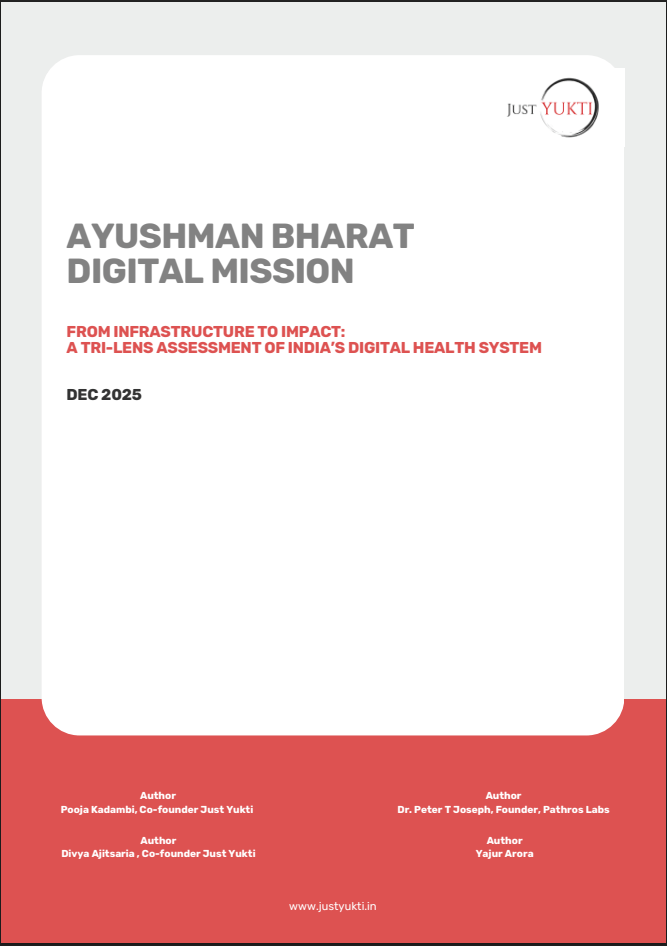
What we found
Well, in a nutshell – we found that some things are working well while others are still catching up.
ABDM’s federated design is a real strength. Instead of one central system, it allows states, hospitals, startups, and payers to build their own solutions on shared rules. That flexibility makes sense for India’s diversity – and it has enabled ecosystem participation.
But federation also brings trade-offs. When everyone can build, ownership of outcomes becomes fuzzy. Adoption depends heavily on local incentives. And today we see that success is often measured by activity – IDs created, systems connected – rather than by lived experience for patients and clinicians.
Another familiar pattern shows up: technology is moving faster than behaviour. The digital rails are mostly in place, but workflows, payments, and habits take longer to change. Globally, digital health only scales when incentives follow – and ABDM is no exception. (In some positive related news though, it seems some states are taking the challenge seriously. UP recently reported sharply improved Ayushman Bharat claim settlements, cutting pendency from over 10 lakh to ~3 lakh and ensuring payments within 30 days. Link)
Trust is the other thread running through the report. India’s privacy and consent direction is strong, but as adoption grows, cybersecurity readiness and operational resilience will matter just as much as policy intent.
The big takeaway: ABDM has built the foundation. The next phase is about alignment – governance, incentives, trust, and outcomes.
We didn’t want to leave it there though – we brought in our Just Yukti touch and came up with six actionable points that we felt would really make ABDM a global case study for leapfrogging – just like UPI.
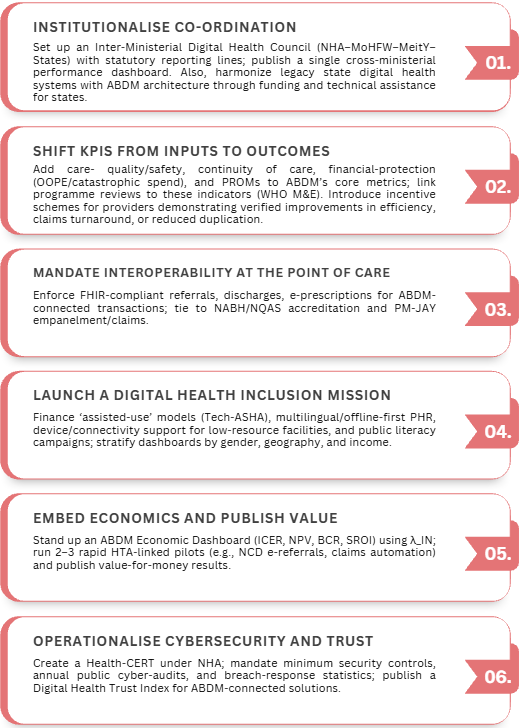
Do read the full whitepaper here: https://papers.ssrn.com/sol3/papers.cfm?abstract_id=5988514 or on our website https://justyukti.in/articles/. Feel free to drop us a line with your thoughts – we are always interested in hearing from you!
MEMO-3 December 2025
The Holiday Reset: Just Yukti’s PILOT Framework for Healthtech Founders

If you are a healthtech founder, you don’t need us to tell you that your journey is hard. Clinical risk, regulatory fog, slow adoption, long sales cycles- these are problems that you probably already have nightmares about.
You may, however, like us to tell you that we’re seeing very encouraging patterns. India’s startup ecosystem is now making massive strides in making things easier for healthtech founders.
State – global partnerships, stronger incubators, and Big Tech infrastructure investments are reducing friction at exactly the stages where startups usually stall. Add to that recent government moves – ABDM maturity, expanded sandbox pathways, continued Startup India tax incentives, and clearer medtech/regulatory playbooks – and the terrain is less hostile than it was even a year ago.
We also see a not so positive pattern – founders don’t know how to capitalize on these initiatives. Yet.
So in this month’s newsletter, we outline how healthtech founders can operate in PILOT mode – and make the path to scale even smoother.
The PILOT Framework
P – Policy leverage: ABDM, health data standards, and regulatory sandboxes aren’t paperwork that you hold your nose and fill – they’re shortcuts to credibility if used correctly.
Maps your products to ABDM building blocks early (Health IDs, consent artefacts) and use regulatory sandbox to pilot updated clinical workflows without full-scale approvals.
Initiate a pre-submission classification discussion to confirm and document the pathway (class, evidence needs, timelines) before writing a single line of clinical claims.
Use Startup India recognition to get benefits such as discounts on patent filing, tax breaks and access to certain government funding.
List products on GeM to access faster procurement pathways with state health departments.
I – Institutions: Technology business incubators, IIT and IISc ecosystems, hospital systems like MUHS, JIPMER and AIIMS are not just co-working spaces and sounding boards. They’re your clinical proof engine.
Partner with a medical college–linked TBI to validate clinical need, review clinical workflows and run observational studies.
Use faculty physicians as co-authors on validation reports. Bonus: having physicians as PIs unlocks grant funding from institutions like AIIMS which may be inaccessible otherwise to the average startup.
L – Large platforms: Cloud, AI, and infra partnerships aren’t “later-stage” problems. They’re how you design for scale and compliance from Day 1
Google Cloud, AWS, Azure – they are already built for hyperscale (secure data storage, AI tooling). Maximize the utilization from day 1.
All these platforms provide startup credits. Use them to simulate scale and stress-test data pipelines.
Design architecture assuming future hospital IT integration – with all of its idiosyncrasies and security standards.
O – Outcomes: not MoUs Use partnerships to run pilots, generate relevant evidence, and unlock adoption – not logo slides.
Have clear pilot metrics: are you reducing readmission, saving clinical time, catching disease earlier, or a mixture of some or all?
Defined timelines and success thresholds with hospital partners make more sense than a PR blitz announcing a vague partnership.
Wherever possible, get written commitment to convert pilots into paid deployments.
Use hospital startup accelerators strategically to get a jumpstart into their procurement process.
T – Trusted: SMEs Clinicians, regulatory experts, hospital ops leaders. Don’t “consult” them – embed them. This is where most founders under-invest and over-pay later. Whether a physician, a regulatory consultant or a clinical expert, use them from day 1.
Funding helps you start. Ecosystems help you survive, validate, and scale. Smart founders leverage the ecosystem to the max, in order to get ahead.
Around the internet – Long Read
Bootstrapping isn’t normally something associated with startups in sectors with slow market cycles like healthtech. However, it’s a rewarding road, especially for founders who value independence and know how to leverage ecosystems. Which is why we loved
Qubit Capital
‘s guide on bootstrapping for healthtech founders. Read it here in its entirety
https://qubit.capital/blog/bootstrapping-healthtech-venture
Grants spotlight
Future of Health Grant (Jan 31st deadline)
: Link to apply
The Future of Health Grant for digital health startups promises CHF 10000 – 50000 in non-dilutive funding for healthtech startups that are considering Switzerland as a potential market for their solutions. There is no barrier to domicile of the startup, with the only requirement being a concrete plan for the Swiss healthcare system, such a pilot project or a market entry partner.
About the newsletter
India’s market rewards those who can navigate, not just innovate. Regulations and red tape aren’t going away — but with the right guidance, they can become your competitive edge.
At Just Yukti, we help you move through India’s complexity with clarity, confidence, and a little strategic yukti.
Subscribe to explore how we turn India’s challenges into opportunities for growth.
MEMO-2 November 2025
Navigating India’s HealthTech Clinical and Regulatory Maze : An IMPACT Guide for Startups

Building a medical device or digital health solution in India can be fun – but navigating approvals, trials, and compliance can feel like driving through unfamiliar territory. With CDSCO, MDR 2017, ICMR, and data laws all in play, it’s easy for your car to grind to a halt. In this second edition of the Yukti Memo, we talk about how the IMPACT framework is a simple way for startups to move forward with clarity and confidence.
🧠 I – Identify the Real Problem
Pre-regulatory/ pre-clinical work is important – and often overlooked. Validate your product/solution through intensive needs validation and immersion. Shadow clinicians, talk to patients, observe workflows – is the problem real, urgent, and unmet? Getting this wrong will be like picking a two door coupe to go off-roading in the Western Ghats – you may eventually complete the journey but you would have probably done it more comfortably with fewer breakdowns in a Jeep with all-wheel drive.
🗺️ M – Map the Intended Use and the Regulatory Landscape
Your intended use defines everything. What does your product do, who is it for, and how is it used? That single sentence determines whether your solution qualifies as a medical device, what class it falls under (A–D per MDR 2017), and whether CDSCO or ICMR oversight applies. Nail your intended use early to avoid surprises down the line – it’s your startup’s compliance GPS.
🔬 P – Plan Clinical Validation
Like test-driving your car, you need to prove your solution works. CDSCO requires clinical trials for higher-risk devices, while digital tools might need usability studies or structured feedback. You also need to be strategic about your site and timeframe – for e.g. if you are building a malaria diagnostic, you will be able to get the bulk of your studies done only in the monsoon when malaria peaks. You may also see a faster outcome in a public hospital in Maharashtra than at AIIMS Rishikesh.
🧪 A – Apply Real-World Evidence (RWE)
Lab tests are one thing – real traffic is another. RWE shows how your product performs in everyday healthcare settings, with actual patients and clinicians. Pilot deployments and observational studies can help build trust, validate claims, and support regulatory submissions. And bonus – you will have a compelling narrative for your sales pitch!
💡 C – Connect with Value via HTA
Getting approved is great; getting adopted is better. Health Technology Assessment (HTA) evaluates whether your product improves outcomes and saves costs – key for government programs or hospital buyers. If your app reduces clinician time or your device lowers complications, capture that data early.
🤝 T – Tap into Guidance & Support
You don’t have to go it alone. Programs like ICMR’s MedTech Mitra (and the team at JustYukti – shameless plug!) offer mentorship and help with clinical and regulatory navigation. Talk to peers, consult experts, and engage with regulators early – they will help you navigate common roadblocks and avoid expensive mistakes that will need time-consuming course corrections later.
With IMPACT as your compass, you can build smarter, navigate faster, and bring innovations to market that truly improve care. And most importantly, you will avoid setbacks that bring you back to square one!
Grants spotlight
Hello Tomorrow (Nov 30 deadline):
Link to apply
The Hello Tomorrow Global Challenge is a global competition that awards €100,000 as a grand prize, plus two additional equity-free prizes of €25,000 for second place and a pre-VC stage category. It is targeted at early-stage deep tech startups or projects worldwide (pre-seed through Series A, with prototype or proof of concept) working on science-driven innovations across sectors.
Biotechnology Industry Research Assistance Council (BIRAC) BIG (Nov 30 deadline):
Link to apply
With up to ₹50 lakh in non-dilutive funding, the 25th call of the BIRAC BIG grant gives early-stage entrepreneurs the freedom to validate risky concepts, build prototypes, and generate the data needed for serious commercial traction. If you’re a scientist-founder or a deep-tech dreamer looking to bridge the gap between lab and market, BIG is designed to be that catalytic first cheque that helps you move fast, experiment confidently, and stand out in India’s growing biotech ecosystem.
About the newsletter
India’s market rewards those who can navigate, not just innovate. Regulations and red tape aren’t going away — but with the right guidance, they can become your competitive edge.
At Just Yukti, we help you move through India’s complexity with clarity, confidence, and a little strategic yukti.
Subscribe to explore how we turn India’s challenges into opportunities for growth.
MEMO-1 October 2025
When Good Ideas Meet India’s Red Tape

AarogyaLink- a promising healthtech startup- set out to make chronic care management affordable and accessible across India. Backed by investors and powered by strong tech, they were ready to scale to five states within a year.
Then came reality.
Roadblock 1- licensing. Each state has a different version of the Clinical Establishments Act: with unique forms, fees, and approval timelines. What worked in Maharashtra failed in Karnataka.
Roadblock 2- data compliance confusion. New state-level rules clashed with central telehealth guidelines.
Roadblock 3- each provider insisted on a pilot, having slightly different clinical protocols and needing separate IRB approvals.
Roadblock x, y and z- tax registrations, labor compliance, unpredictable audits, and so on..
The founders were soon spending more time navigating portals than serving patients.
This is the hidden complexity of doing business in India- the federated governance structure, where both central and state authorities play vital roles in regulation and oversight. While this system ensures that local priorities are respected and consumer protection remains strong, it also means that businesses must adapt to varied processes and evolving guidelines across regions. Many startups discover that local nuances and policy ambiguity can slow innovation more than competition does.
AarogyaLink might be fictional – but their story is all too real. At Just Yukti, we help startups navigate exactly this complexity. We turn market uncertainties into actionable clarity- powered by deep functional expertise and born out of the blood, sweat and tears of having done it all before.
We are your experts available on a tap, your fractional CXOs. But most importantly, we are your partners in the trenches, with our sleeves rolled up.
This newsletter is a record of our learnings, a GPS for founders. Here, we’ll unpack key policy developments, share insights from the field, and offer candid (sometimes counter-intuitive) pointers on what really works- and what doesn’t – in the Indian market.
We’ll also keep you updated on funding opportunities for startups and MSMEs.
Stay tuned – clarity is coming.
India’s Tax System Just Got an Upgrade
A simplified GST structure- and what you need to do to ensure compliance.
Think of GST 2.0 as the long-overdue software update India’s tax system desperately needed- fewer bugs, faster performance, and a much cleaner interface. Launched on September 22, 2025, this reform trims the old four-slab maze into just two main rates- 5% and 18% (plus 40% for luxury and sin goods).
For startups, it’s a serious upgrade, dramatically cutting compliance burdens that previously consumed valuable startup resources. With essentials like office equipment, healthcare, and business services moving into lower tax brackets, pricing structures are simpler, cash flow gets smoother, and founders can focus on building instead of endlessly reconciling invoices.
What can you do with this information?
Update Systems Immediately (Deadline October 31, 2025): Reconfigure billing software, ERP systems, and invoice templates for the new 5%/18% structure. Update e-commerce platforms and POS systems to prevent compliance penalties.
Verify HSN Codes & Pricing: Review every product/service – many products and services have changed categories e.g. essentials moved to 5%, most items standardized at 18%. Update MRP labels by December 31st and renegotiate supplier contracts to reflect new rates.
Fast-Track Registration Benefits: New startups get 3-day GST registration (vs. previous 30 days). Voluntary registration under ₹40L turnover unlocks input credits and B2B credibility.
Optimize Cash Flow: Leverage 90% faster refunds – set up automated reconciliation for sub-30 day refund cycles. Businesses under ₹2 crore skip annual return filing starting FY 2024-25.
Automate Compliance: Implement e-invoicing for threshold businesses and complete Aadhaar authentication for refund eligibility (if you haven’t already). Set automated reminders: GSTR-1 by 11th, GSTR-3B by 20th monthly.
GST and taxation might seem incredibly boring compared to building, but they are some of the most common red-flags seen during investor diligence. We think it is better to deal with a little boredom now rather than scrambling a night before a VC pitch or- worse- when you receive a notice from the IT department!
Grant Spotlight
PRIP Scheme (Nov 3 deadline)
– Link to apply
The PRIP (Promotion of Research & Innovation in Pharma-MedTech) scheme offers a ₹5,000 crore total outlay. It supports industry-academia collaborations, pharma/MedTech firms, MSMEs and startups through grants (up to ₹100 crore in late-stage projects, up to ₹5 crore in early stage) across a six priority area portfolio.
The PRIP (Promotion of Research & Innovation in Pharma-MedTech) scheme offers a ₹5,000 crore total outlay. It supports industry-academia collaborations, pharma/MedTech firms, MSMEs and startups through grants (up to ₹100 crore in late-stage projects, up to ₹5 crore in early stage) across a six priority area portfolio.
Indian Council of Medical Research (ICMR)
,
Department of Pharmaceuticals
Hello Tomorrow Global Challenge (Nov 30 deadline)
The Hello Tomorrow Global Challenge is a global competition that awards €100,000 as a grand prize, plus two additional equity-free prizes of €25,000 for second place and a pre-VC stage category. It is targeted at early-stage deep tech startups or projects worldwide (pre-seed through Series A, with prototype or proof of concept) working on science-driven innovations across sectors.
About the newsletter
India’s market rewards those who can navigate, not just innovate. Regulations and red tape aren’t going away — but with the right guidance, they can become your competitive edge.
At Just Yukti, we help you move through India’s complexity with clarity, confidence, and a little strategic yukti.
Subscribe to explore how we turn India’s challenges into opportunities for growth.
 Just Yukti